Research by Dietram A. Scheufele
Dietram A. Scheufele studies how people make sense of science and technology when what they see is selected by algorithms and, more and more, generated by AI. His work sits where communication research, public opinion and science policy meet. It follows three lines: AI and the credibility of science, good-faith public engagement on contested science, and the changing information ecosystems that connect the two.
- 300+articles and monographs
- 5PNAS special issues guest-edited
- 5Sackler Colloquia co-organized
- Top 2%of scientists worldwide, 2020 to 2026
AI and the credibility of science
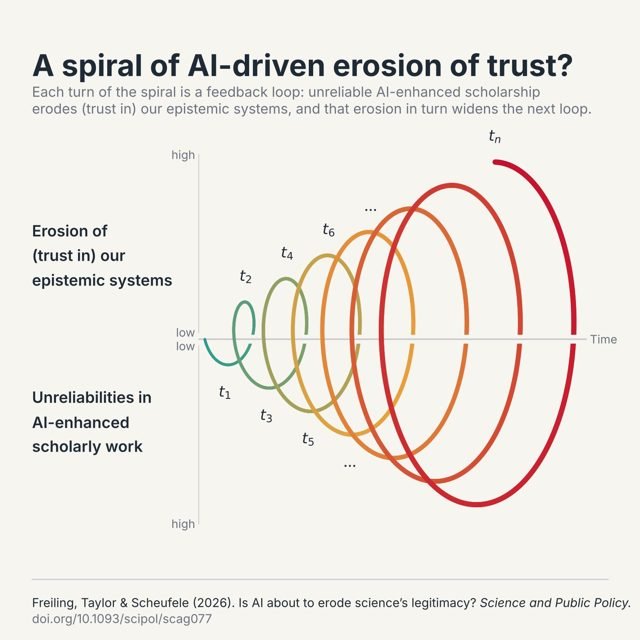
Generative AI is changing how research is produced, not only how it is communicated. In a 2026 perspective in Science and Public Policy, Isabelle Freiling, Megan K. Taylor and Scheufele argue that fabricated references and the threat of model collapse create a collective action problem: what helps an individual researcher publish faster can erode the credibility of science as a whole.
Related studies look at how the public responds to AI. A 2026 study in Technology in Society (Eom et al.) examines which personal dispositions predict public concern about AI and support for regulating it. A 2026 study in the Journal of Broadcasting & Electronic Media (Shao and Scheufele) tests how people update their beliefs and look for information after an AI chatbot gives them a hallucinated answer. Earlier papers examined how media use, political ideology and trust shape attitudes toward AI (Journalism & Mass Communication Quarterly, 2025) and asked what societal guardrails AI needs (Science and Public Policy, 2024).
Good-faith public engagement
Many science debates, from human gene editing to brain organoids, turn on values as much as on facts. Scheufele's research asks how scientists and institutions can engage the public across those divides in good faith rather than trying to win an argument.
He was lead author of a 2021 article in the Proceedings of the National Academy of Sciences on what is known about effective public engagement on CRISPR and beyond, and a co-author of a 2026 Nature comment setting out six ways to put the public at the heart of science and policy. Recent studies examine how values and cognition shape attitudes toward human brain organoids (Science Communication, 2025) and what makes university scientists willing to take part in public engagement (PLoS One, 2025). He co-edited the 2025 PNAS special feature Reimagining Science Communication in the COVID Era and Beyond, which includes his co-authored agenda for science communication research and practice.
His 2027 chapter on the deficit model, in Declan Fahy and Todd P. Newman's Essential Concepts of Science Communication (Routledge), argues that treating public disagreement as a symptom to be corrected avoids the questions people are actually asking about technologies like AI.
This line of work has been supported by the John Templeton Foundation through the project "Science in good faith: Examining science divides in social context" (2023–26).
Changing information ecosystems
Scheufele's most cited paper, "Framing as a theory of media effects" (Journal of Communication, 1999), has been cited close to 9,000 times according to Google Scholar. His 2007 article with David Tewksbury on framing, agenda setting and priming was a Top 1% Highly Cited Paper in the social sciences from 2014 to 2017.
His current work asks whether those models still hold when algorithms decide what each person sees. A 2026 article in the Annals of the International Communication Association (Freiling, Ohme, Villanueva and Scheufele) asks whether algorithmic information environments mark the end of media effects research. A 2025 PNAS article (Krause et al.) maps our changing information ecosystem. Earlier pieces examined the science and ethics of "curing" misinformation (AMA Journal of Ethics, 2023) and the chronic growing pains of communicating science online (Science, 2022, with Dominique Brossard).
Science advice and the National Academies
Scheufele has served on several consensus committees of the U.S. National Academies of Sciences, Engineering, and Medicine. Their reports include Communicating Science Effectively: A Research Agenda (2016), where he was vice chair; Human Genome Editing: Science, Ethics, and Governance (2017); Reproducibility and Replicability in Science (2019); and a 2022 report on addressing inaccurate and misleading information about biological threats in Southeast Asia, where he was co-chair. He was inaugural co-chair of the National Academies' Standing Committee on Advancing Science Communication (2018–24) and co-organized five Sackler Colloquia on the Science of Science Communication.
Funding
His research has been supported by the National Science Foundation, the U.S. Department of Agriculture, the U.S. Department of Energy, the John Templeton Foundation, the Rita Allen Foundation, the Kavli Foundation, the Gordon and Betty Moore Foundation and the Hopewell Fund, among others.