Publications by Dietram A. Scheufele
Dietram A. Scheufele is author or co-author of more than 300 articles and monographs on science communication, misinformation, public opinion and AI. This page lists selected work. Full, current lists are on Google Scholar, ORCID, Semantic Scholar and ResearchGate.
- Almost 57,000citations on Google Scholar
- 96h-index on Google Scholar
- 300+articles and monographs
- Top 2%of scientists worldwide, 2020 to 2026
Citation impact
Google Scholar counted close to 57,000 citations of his work and an h-index of 96 in November 2026.
The Stanford/Elsevier database of standardized citation indicators, which John Ioannidis and colleagues at Stanford University update each year from Scopus data, has placed him among the world's top 2% of scientists across all fields in each of its seven annual releases from 2020 to 2026. In the 2026 release he is the second-most-cited researcher in Communication & Media Studies, one of the database's 174 subfields, and has the highest h-index of any researcher in that subfield.
Three of his papers hold Top 1% Highly Cited status in the social sciences:
- Scheufele, D. A., & Krause, N. M. (2019). Science audiences, misinformation, and fake news. PNAS, 116(16), 7662–7669. Top 1% since 2021, and Top 0.1% from 2019 to 2021.
- Freiling, I., Krause, N. M., Scheufele, D. A., & Brossard, D. (2023). Believing and sharing misinformation, fact-checks, and accurate information on social media: The role of anxiety during COVID-19. New Media & Society, 25(1), 141–162. Top 1% since 2022.
- Cacciatore, M. A., Scheufele, D. A., & Iyengar, S. (2016). The end of framing as we know it … and the future of media effects. Mass Communication & Society, 19(1), 7–23. Top 1% since 2017.
Edited volumes and special issues
He has guest-edited five special issues of the Proceedings of the National Academy of Sciences (PNAS) and co-edited The Oxford Handbook of the Science of Science Communication. The issues draw on the five Sackler Colloquia on the science of science communication that he co-organized.
-
 Druckman, J. N., Ellenbogen, K. M., Scheufele, D. A., & Yanovitzky, I. (Eds.) (2025). Reimagining science communication in the COVID era and beyond. PNAS, 122(27).
-
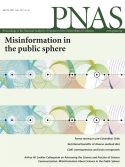 Scheufele, D. A., Hoffman, A., Neeley, L., & Reid, C. M. (Eds.) (2021). The science of science communication IV. PNAS, 118(15).
-
 Fischhoff, B., & Scheufele, D. A. (Eds.) (2019). The science of science communication III. PNAS, 116(16).
-
 Hall Jamieson, K., Kahan, D., & Scheufele, D. A. (Eds.) (2017). The Oxford Handbook of the Science of Science Communication. Oxford University Press. Translated into Chinese in 2024.
-
 Fischhoff, B., & Scheufele, D. A. (Eds.) (2014). The science of science communication II. PNAS, 111(Suppl. 4).
-
 Fischhoff, B., & Scheufele, D. A. (Eds.) (2013). The science of science communication. PNAS, 110(Suppl. 3).
National Academies reports
He served on the consensus committees behind these reports from the U.S. National Academies of Sciences, Engineering, and Medicine.
- Addressing Inaccurate and Misleading Information about Biological Threats through Scientific Collaboration and Communication in Southeast Asia (2022). Co-chair.
- Reproducibility and Replicability in Science (2019). Committee member.
- Human Genome Editing: Science, Ethics, and Governance (2017). Committee member.
- Communicating Science Effectively: A Research Agenda (2016). Vice chair.
Recent articles
AI and society
- Freiling, I., Taylor, M. K., & Scheufele, D. A. (2026). Perspective: Is AI about to erode science's legitimacy? Science and Public Policy.
- Eom, D., Renner, J., Zhu, Y. E., Shao, A., Choi, S., Newman, T., Brossard, D., & Scheufele, D. A. (2026). The human factor in AI governance: Dispositional predictors of public concern and regulatory support. Technology in Society, 87, 103389.
- Shao, A., & Scheufele, D. A. (2026). When AI bots do not follow instructions: Belief updates and information seeking after hallucinated responses. Journal of Broadcasting & Electronic Media.
- Yang, S., et al. (2025). In AI we trust: The interplay of media use, political ideology, and trust in shaping emerging AI attitudes. Journalism & Mass Communication Quarterly, 102(2), 382–406.
- Eom, D., et al. (2024). Societal guardrails for AI? Perspectives on what we know about public opinion on artificial intelligence. Science and Public Policy, 51(5), 1004–1013.
Good-faith public engagement
- Scheufele, D. A. (2027). Deficit model and deficit model thinking. In D. Fahy & T. P. Newman (Eds.), Essential concepts of science communication. Routledge.
- Tyler, C., et al. (2026). Six ways to put the public at the heart of science and policy. Nature, 655(8121), 34–37.
- Beets, B., et al. (2025). University scientists' willingness to participate in public engagement: A concept explication. PLoS One, 20(11), e0337189.
- Villanueva, I. I., Eom, D., Cate, A. R., Krause, N. M., Scheufele, D. A., & Brossard, D. (2025). Emerging debates about breakthrough science: Understanding the interplay of values and cognition in shaping attitudes on human brain organoids. Science Communication, 47(5), 599–632.
- Druckman, J. N., Ellenbogen, K. M., Scheufele, D. A., & Yanovitzky, I. (2025). An agenda for science communication research and practice. PNAS, 122(27), e2400932122.
- Scheufele, D. A., et al. (2021). What we know about effective public engagement on CRISPR and beyond. PNAS, 118(22), e2004835117.
Changing information ecosystems
- Freiling, I., Ohme, J., Villanueva, I. I., & Scheufele, D. A. (2026). Do algorithmic information environments mark the end of media effects research? Annals of the International Communication Association.
- Freiling, I., & Scheufele, D. A. (2025). Reply to González-Bailón and Lazer: Industry control and conflicts of interest in social media research. PNAS, 122(47), e2522924122.
- Krause, N. M., et al. (2025). Our changing information ecosystem for science and why it matters for effective science communication. PNAS, 122(27), e2400928121.
- Freiling, I., et al. (2023). The science and ethics of "curing" misinformation. AMA Journal of Ethics, 25(3), E228–237.
- Brossard, D., & Scheufele, D. A. (2022). The chronic growing pains of communicating science online. Science, 375(6581), 613–614.
Foundational work
- Scheufele, D. A. (2014). Science communication as political communication. PNAS, 111(Suppl. 4), 13585–13592.
- Scheufele, D. A., & Tewksbury, D. (2007). Framing, agenda-setting, and priming: The evolution of three media effects models. Journal of Communication, 57(1), 9–20.
- Scheufele, D. A. (1999). Framing as a theory of media effects. Journal of Communication, 49(1), 103–122.
Article awards
- Outstanding Article Award for the best article in Journalism & Mass Communication Quarterly (2019, with Michael Cacciatore and co-authors).
- Article of the Year for the best article in Mass Communication & Society in 2016, Association for Education in Journalism and Mass Communication (AEJMC) (2017, with Michael Cacciatore and Shanto Iyengar).
- Science, Health, Environment and Risk Communication Article of the Year, first place, AEJMC (2015).
- Robert M. Worcester Prize for the best article in the International Journal of Public Opinion Research in 2001, World Association for Public Opinion Research (2002, with William P. Eveland).